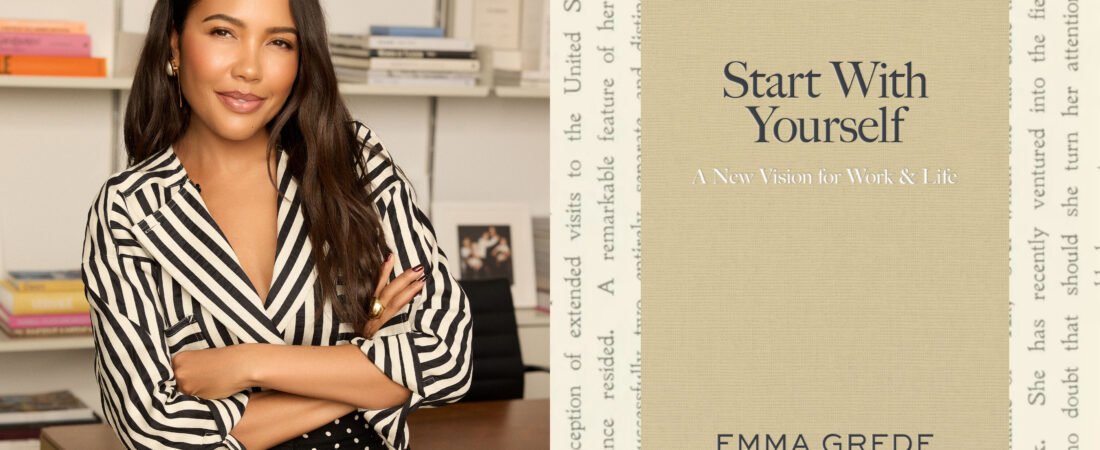
There is a specific kind of magic that happens when someone who has built multi-billion dollar brands decides to strip away the glossy PR filters and speak with absolute, unvarnished honesty. On the launch day of her highly anticipated debut book, Start with Yourself, Emma Grede sat down on her Aspire podcast to unpack exactly what it takes to climb from a chaotic East London council estate to the top of the global business landscape.
If you are expecting a soft, comforting self-help guide filled with trending manifestation phrases, you are looking in the wrong place. This is a direct, conversational breakdown of her no-nonsense philosophy on career, fertility, raw effort, and why the most critical step to changing your life is looking squarely in the mirror.
1. Dismantling the Smoke and Mirrors of Modern Self-Help
Let’s be completely real: the modern wellness and career spaces are thoroughly saturated with advice that feels incredibly comfortable but changes absolutely nothing. We are constantly told to close our eyes, visualize our dream realities, build beautiful boards, and wait for the universe to deliver our goals on a silver platter. Emma Grede wastes no time in tearing down this comforting narrative. Right out of the gate, she establishes that her book is not a magic wand, nor is it designed to soothe your ego.
“I will never lie to you. I will never overpromise or simplify things. I will never tell you that you can manifest your way to success or vision board your way to making millions. If that shit worked, more people would have more success. Ambition has to find you working, and ambition requires discomfort.”
This perspective serves as the absolute foundation of her career journey. Grede acknowledges that while visualizing your future is an excellent way to establish a target, the real magic happens in the sweat equity you deposit daily. True success requires a distinct brand of audacity, but it is an audacity that must be paired with an unrelenting work ethic. If you want to be paid what you are worth, you have to possess the drive to back up your claims when you enter the room.
The core goal of her book is to hold up a mirror to the reader. It is an uncomfortable exercise because it forces us to acknowledge that some of the greatest barriers in our way are not external systems, but our own patterns, excuses, and fears. While it is painful to recognize that we are often holding ourselves back, Grede reminds us that this realization is actually the ultimate form of liberation. If you are the one causing the stagnation, you are also the only one who possesses the absolute power to change it. Wasting your limited mental energy on things entirely outside of your control is a massive drain on your focus and creativity.
2. What It Actually Means to “Start with Yourself”
The title of the book isn’t just a catchy phrase; it is Grede’s personal life philosophy. To truly start with yourself, you have to make a radical, intentional commitment to put yourself at the very top of your priority list every single day. For many women—especially mothers, team players, and corporate leaders—this sounds almost entirely counterintuitive. We have been socially programmed to view self-prioritization as a selfish act, trained instead to place our children, partners, employers, and colleagues far ahead of our own basic needs.
Grede completely flips this narrative. Prioritizing yourself isn’t about neglecting others; it is about establishing the mental and emotional reserve required to lead effectively. If you are constantly running on fumes, you have absolutely nothing of substance to offer the people relying on your guidance.
Beyond self-care, starting with yourself means accepting extreme, radical self-responsibility. It means taking total ownership of your current thoughts, your day-to-day attitude, your ongoing learning, and, most importantly, your failures. There are no excuses allowed in this framework. When something goes wrong in your career or business, the instinctive human reaction is to look outward—to blame a difficult market, a bad boss, or an unfair system. Grede challenges us to drop the victim mentality entirely, gather ourselves after a heavy loss, forgive our missteps, and focus purely on the elements we can directly command.
3. The Hardest Lesson: Mastering Emotional Literacy
When drafting the text, Grede initially assumed she would write a standard business manual focused on capital value, building scale, and navigating corporate structures. However, a deep period of self-reflection forced her to realize that her technical business skills weren’t what truly set her apart. The real engine behind her trajectory was her mindset and her ability to navigate her internal landscape.
She admits that the most challenging and highly personal chapter to write was the one centered on managing emotions. For women, emotional intelligence and literacy are natural superpowers. They allow us to read a room instantly, tap into subtle shifts in cultural trends, and understand the deep motivations of the people around us. Your gut intuition is an incredible data source, but it becomes a massive liability if you do not learn how to modulate and manage it.
“Our feelings are an essential source of information… but you cannot live a healthy or functional life if you’re running a decision-making process based on your anger or your fear or your guilt. It just isn’t possible.”
Grede speaks candidly about the trap of self-betrayal, particularly how women frequently agree to things they absolutely do not want to do out of deep-seated guilt or a desire to appease others. Every single time you say yes to an external demand while your internal voice is screaming no, you commit a quiet act of betrayal against yourself. To build an authentic life and a sustainable career, you have to clear the emotional decks. By looking deeply at chapters dedicated to fear, anger, guilt, and joy, the book provides an actionable system to process these feelings so they inform your next steps rather than dictating your long-term strategy.
4. Dropping the Illusion of Work-Life Balance
If you are searching for a validation of the typical modern corporate wellness package, you will not find it here. Grede addresses the major social media backlash she received after an appearance on the Diary of a CEO podcast, where she stated that work-life balance is an individual problem rather than an employer’s responsibility. She stands by that claim with absolute certainty, arguing that chasing a perfect, static balance is entirely the wrong goal.
The Shift to Alignment
Instead of wasting valuable hours searching for an elusive split between life and work, Grede advocates for alignment to your ultimate ambition. If you want to build something monumental, become best-in-class, or generate life-changing wealth, you have to accept that there will be periods where you must go completely all-in. An extraordinary career is never the byproduct of ordinary, comfortable effort. It demands long hours, intense focus, and a willingness to embrace temporary imbalance to achieve your long-range milestones.
The Hidden Cost of Remote Work
In an era where remote work is championed as the ultimate modern luxury, Grede drops a truth bomb that might feel incredibly unpopular: remote work is a quiet form of career suicide for highly ambitious people. She emphasizes that what is lost through a digital screen is absolutely profound.
When you work in complete isolation, you miss out on the rapid, on-the-fly exchanges that happen naturally in a dynamic, in-person environment. You cannot effectively shadow a mentor, observe how a leader navigates a high-stakes crisis, or absorb the subtle nuances of corporate culture through a Zoom link. Proximity is power. If your goal is to sit at the decision-making table or scale a business, being connected and physically present is the only reliable way to ensure your growth doesn’t decelerate. Modern life has introduced an element of self-imposed solitude through online shopping and social feeds, and both our professional networks and personal relationships are suffering heavily because of it.
5. A Candid Perspective on Career, Family, and Fertility
As a mother of four children who has built global brands simultaneously, Grede receives endless questions from young women trying to figure out the perfect sequence for starting a family. Should you dial in your career first, or should you focus on family while you are still navigating your early professional steps?
Grede’s response is characteristically direct, bypassing comforting platitudes to address a harsh biological reality that many modern professional spaces deliberately gloss over.
The Hard Biological Data on Fertility
Grede emphasizes that while careers can always be rebuilt and recovered, a woman’s fertility window is finite. Modern narratives often treat advanced medical interventions as a guaranteed safety net, but the actual live birth success rates using a woman’s own eggs show a steep biological decline:
- Under 35 years old: 55% success rate
- 35 to 37 years old: 41% success rate
- 38 to 40 years old: 27% success rate
- 41 to 42 years old: Drops sharply to between 13% and 4%
She notes that modern parenting standards have become entirely over-ambitious, with mothers treating child-rearing like an intense, demanding second full-time job. She encourages women to stop being ambitious on behalf of their kids, to realize that children do not need every single curated luxury the internet tells you to buy, and to simplify the entire process. Waiting around for the perfect financial stability or the ideal, flawless partner is a fast track to losing your options entirely. Your career is resilient; it can recover from a temporary pause, but your biological clock will not wait for corporate equity to arrive.
6. From East London Chaos to the Forbes Self-Made List
To truly understand the weight of Emma Grede’s words, you have to look at the landscape that forged her. Reading directly from the introduction of Start with Yourself, she paints a vivid picture of her childhood on the 10th floor of a grey, concrete council estate in Stratford, East London. It was a tough, hyper-vigilant neighborhood where fear was a constant companion and getting your bike stolen was a standard afternoon occurrence.
Her extended family circle felt like a casting call for a fast-talking British gangster movie. Raised by a single mother and a completely absent father, the predetermined path for women in her environment was clear: become a sidepiece to a footballer, date a local DJ, or marry a neighborhood gangster. Most of the women around her fell into well-worn grooves of financial dead-ends and deep emotional heartbreak.
A definitive turning point occurred when she was just 17 years old. Her close family friend, Marcus, called her to announce he had been arrested, instructing her to stay away from their flat so a mutual contact could clear out his remaining contraband. Marcus ended up serving 22 years in prison. Yet, on the absolute edge of his personal abyss, his primary thought was to protect Emma’s safety and future. That moment became highly symbolic for her; it gave her the knowledge that someone had immense faith in her potential, and she realized she needed to build a bridge from the world she inhabited to the world where she actually wanted to live.
She eventually dropped out of high school after being labeled disruptive—discovering only as an adult that she was navigating severe dyslexia. She subsequently dropped out of the London College of Fashion because she simply couldn’t afford the tuition. Yet, by the age of 40, she had engineered a reality that absolutely nobody in her early life would have predicted: launching multiple massive brands, securing a spot on the Forbes America’s Richest Self-Made Women list, and cultivating a warm, supportive 16-year marriage.
7. The Takeaway: Stop Waiting for a Fair World
Grede refuses to engage in toxic positivity. She openly acknowledges that the world is inherently inequitable and significantly harder for women, people of color, and individuals coming from systemic poverty. She knows firsthand that the corporate landscape rarely creates ideal conditions for mothers to scale businesses, and she points out the blatant cultural double standard where powerful men are celebrated for their single-minded focus while ambitious women are labeled as aggressive or full of themselves.
But her final conclusion is a rallying cry for self-determination: we cannot afford to sit around and wait for the world to become fair or meet our personal preferences before we take massive action. Blaming systemic issues might be entirely valid, but it is not how tangible change occurs. If you want to transform your trajectory, you have to stop acting like a passenger in your own life. Get on your own team, choose yourself first, master your internal emotional world, and build the future you want on your own absolute terms.
Start with Yourself is available globally. You can catch Emma Grede live on her official multi-city book tour starting this month.